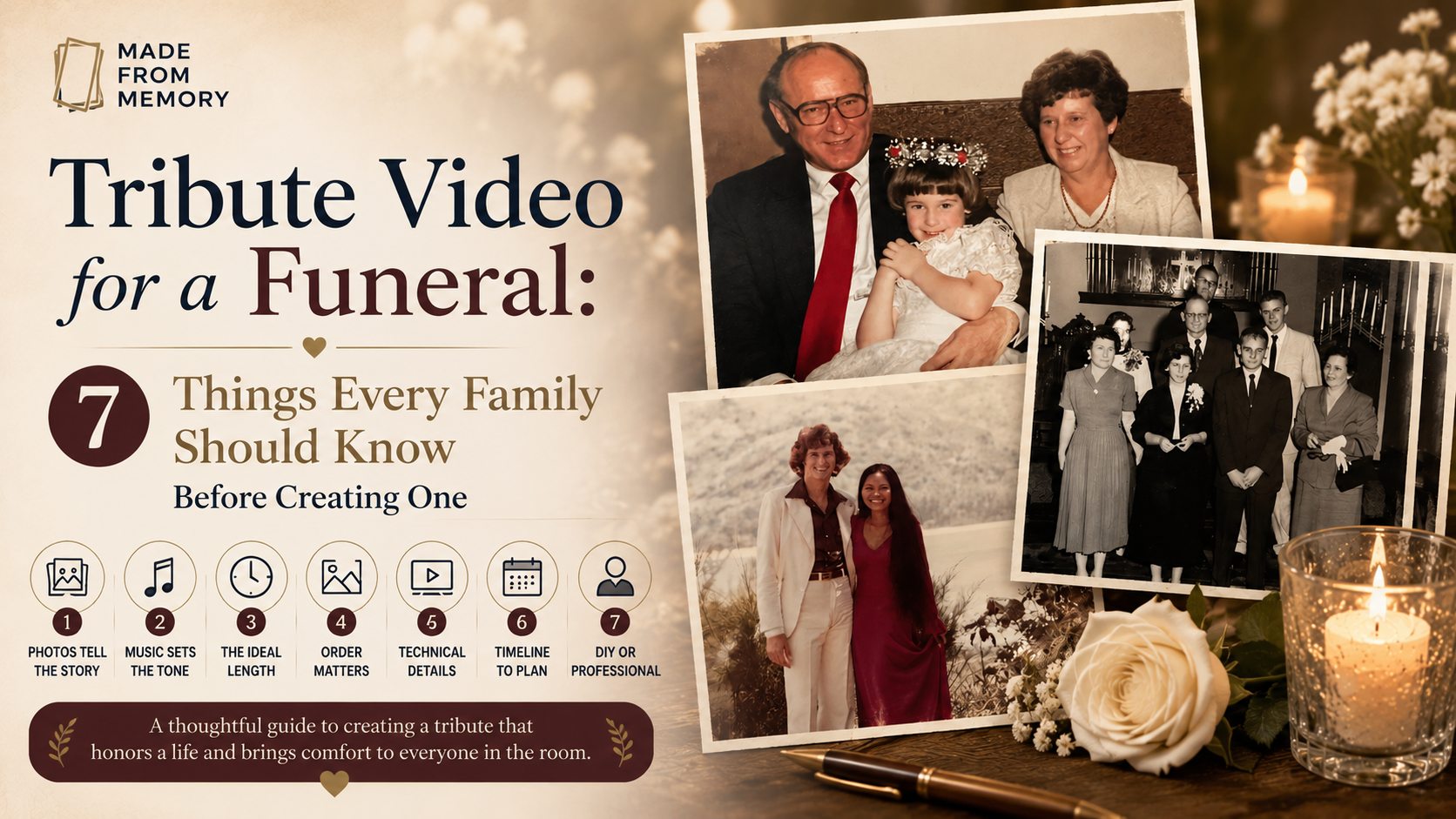
Before creating a tribute video for a funeral, families should know seven important things: photographs matter less than the story they tell together, music carries more emotional weight than any single image, the ideal length is between four and seven minutes, the order of images shapes how the room feels, technical playback details (file format, audio, screen) need to be confirmed in advance, the timeline from first idea to finished video is usually five to fourteen days, and the choice between doing it yourself and hiring a professional is genuinely consequential (each has its place). The most common regret families share afterward is rushing the process and ending up with something that did not feel like the person it was meant to honor.
This guide walks through each of the seven things in depth, with practical advice for families making these decisions in the few days or weeks between a loss and a funeral service. It is written for the family member who has been handed the tribute as their responsibility, and who wants to do right by the person they lost.
A Word Before We Begin
If you are reading this in the week of a funeral (or the week before one) you are carrying a particular kind of weight. The grief is still raw. The phone keeps ringing. There is paperwork. There are relatives arriving. And somewhere on your list, in handwriting that feels like it belongs to someone else, you have written: “make the tribute video.”
This article exists for that moment.
The goal here is not to make you a professional video editor. The goal is to give you a clear understanding of the seven things that genuinely shape whether a funeral tribute video feels like the person it honors, so that whether you make it yourself or hire someone, the result reflects the love behind it.
You do not need to read this in one sitting. You can come back to it section by section as the decisions arise. Take your time. The person you are honoring is not in a hurry.
Thing One: The Photographs Matter, But the Story Matters More
The most common mistake families make when starting a tribute video is treating the project as a photo selection exercise. They open the shoebox or the cloud folder, and they start picking favorites.
That is the wrong starting point.
The right starting point is to ask: what is the story we want this video to tell? Not what photographs do we have. What story.
There are several kinds of stories a tribute can tell. Each one selects different photographs.
The chronological life story tells the person’s arc from childhood through their final years. It includes photographs from every decade, gives roughly equal weight to each, and ends with a recent image. This is the most common structure and works for most people.
The “who they were to us” story tells the person through their relationships and roles. It might include them as a child, as a young spouse, as a parent, as a grandparent, as a friend. Photographs are chosen for what they show about the person’s connections, not for the chronology.
The “what they loved” story tells the person through their passions and interests. The garden, the fishing trips, the volunteer work, the church choir, the workshop in the basement. Photographs are chosen for what they reveal about how the person spent their days.
The “what they gave us” story is more intimate and is often used when the person had a particularly defined role (a mother, a teacher, a mentor). Photographs are chosen for moments that show what they offered to others.
Most tributes blend these structures. A typical funeral tribute might be 60 percent chronological, with thematic clusters woven in (a section of “the garden years,” a moment of “with their grandchildren,” a sweep of “the trips they took”). The blend is what makes a tribute feel like a story rather than a slideshow.
Once you know the story, the photographs reveal themselves. You stop second-guessing every image. You start asking: does this photograph belong in this story? If yes, in. If no, out. The work becomes much easier.
Thing Two: The Music Choice Will Make or Break the Tribute
If you only get one thing right, get the music right.
Photographs are the body of a tribute. Music is the heartbeat. The wrong song can make beautiful photographs feel hollow. The right song can make ordinary photographs feel sacred.
What Makes a Song Right
A song is right for a tribute if it does at least one of three things. It reflects who the person was (their taste, their era, their personality). It carries family meaning (a song from a meaningful family moment). Or it provides the emotional shape the tribute needs (a gentle build, a meaningful chorus, a soft landing).
The best songs do all three.
Common Funeral Tribute Music Choices
Some songs appear in many funeral tributes because they reliably work: “Wind Beneath My Wings,” “Amazing Grace,” “Time to Say Goodbye,” “What a Wonderful World,” “Somewhere Over the Rainbow,” “Hallelujah,” “You’ll Never Walk Alone,” “Tears in Heaven,” “Fly Me to the Moon,” “My Way.” These songs work because they have proven emotional arcs and broad familiarity.
However: a tribute that uses the obvious song for the genre rather than the right song for the person can feel generic. The grandmother who loved Patsy Cline deserves Patsy Cline at her funeral, not “Wind Beneath My Wings.” The father who never went to church does not need a hymn. Match the song to the person, not the genre.
Instrumental vs. Vocal
Instrumental music (solo piano, gentle strings, acoustic guitar) is often less distracting than vocal music, because the listener’s attention stays on the photographs. Vocal music brings its own emotional weight, but the lyrics compete for attention with the images.
A useful approach: open the tribute with an instrumental piece, transition into one vocal song at the emotional center, and close with a return to instrumental or quiet vocal. This gives the room space to breathe.
How Many Songs
For a five-minute tribute, one well-chosen song with a clear emotional arc is often perfect. For longer tributes, two or three songs with thoughtful transitions work well. Avoid more than four songs: the transitions begin to break the emotional continuity.
A Note on Music Licensing for Funerals
For tributes shown privately at a funeral service or memorial gathering, music licensing is generally not a legal issue (this falls under fair use for private gatherings in most jurisdictions). For tributes that will be posted publicly online afterward, licensing can become more complicated. If public sharing matters, consider royalty-free music or work with a service that handles licensing.
Thing Three: Length Matters More Than You Think
A funeral tribute video should be between four and seven minutes long for most circumstances. There are reasons for this, and they matter.
Why Shorter Than Four Minutes Does Not Work Well
A tribute under four minutes cannot accommodate the photographs needed to tell a meaningful life story. With each photograph held for three to six seconds, four minutes provides space for roughly 40 to 80 photographs. Less than that, and the story feels rushed. The audience feels the tribute is ending before they have fully arrived in it.
Why Longer Than Seven Minutes Often Fails
A tribute longer than seven minutes faces several problems. The emotional intensity of the room cannot sustain itself indefinitely. The audience’s attention starts to wander, even with beautiful photographs. The pacing of the service is disrupted (most funeral services have a tight schedule). And the final image, when it finally arrives, has less impact because the audience has already been emotionally pulled through too many peaks.
The Sweet Spot
Five to six minutes is the sweet spot for most funeral tributes. It allows for 50 to 80 photographs, two pieces of music, gentle transitions, and a clear opening and closing without overstaying.
Exceptions to the Rule
Some situations call for longer tributes. A celebration of life held weeks or months after the death often has a more relaxed schedule and can accommodate seven to ten minutes. A tribute that includes significant video footage (not just photographs) may need additional time to honor those clips. A tribute for someone who lived a particularly long and well-documented life may genuinely need more time to do them justice.
If you are leaning toward a longer tribute, talk to the officiant or funeral director about how it will fit into the service. They will tell you honestly whether the audience can hold it.
Thing Four: The Order of Images Shapes How the Room Feels
A tribute is not just a collection of photographs. It is a sequence. The order in which images appear shapes how the audience experiences the entire piece.
The Three Acts of a Tribute
Most successful funeral tributes follow a three-act structure, whether the creator knows it or not.
Act One opens with the person at peace. A quiet portrait, a moment of joy, an image that says “this is the person you came here to honor.” It is often a recent photograph, or one of their most well-known images. The audience needs to recognize the person immediately.
Act Two moves through their life. This is the body of the tribute. Childhood. Young adulthood. Marriage and family. Career and passions. The decades pass. The pace is steady. The music supports the emotional weight.
Act Three returns to a sense of peace. The tribute slows. The final images are quieter, often more recent, often more reflective. The audience is given a soft landing rather than a hard cut.
This three-act structure works because it mirrors how the human mind processes emotional experience: arrival, journey, return. It is also why “random order” tributes (where photographs appear without any clear sequence) often feel emotionally unsatisfying, even when the individual images are beautiful.
Where the Heavy Moments Belong
The heaviest emotional moments of a tribute (the wedding photo, the last family portrait, the image of the person in their final year) should not be at the very beginning or the very end. They belong in the second half of the tribute, where they can land in a room that has been gently prepared, and where the audience still has time to recover before the close.
The Closing Image
The last image of a tribute is the one the audience carries out of the room. Choose it with extra care. Common strong closing images: a quiet portrait of the person at peace, an image of them looking up or smiling gently, an image of them in a place that mattered, an image with the person’s name and dates simply overlaid. The closing image should feel like a goodbye that is not a tragedy.
Thing Five: Technical Details Will Determine Whether It Plays
A beautiful tribute that cannot be played at the funeral is a tragedy. The technical details are not glamorous, but they matter as much as anything else.
File Format
The standard format for a funeral tribute is MP4 (specifically H.264 video codec, AAC audio codec). This is the most universally supported format across funeral home systems, laptops, projectors, and televisions. Avoid more exotic formats unless you have specifically confirmed they will play.
Resolution
HD (1920 x 1080) is the current standard and works on essentially every modern display. 4K is overkill for most funeral settings and creates much larger file sizes that can cause playback problems on older equipment.
Audio Levels
Audio levels are the single most-common technical problem at funerals. The tribute plays beautifully on the laptop where it was made, then plays too quietly (or too loudly) in the funeral home or church. Test the audio at the actual venue if at all possible. If you cannot test in advance, slightly over-normalize the audio so it has room to be adjusted down rather than needing to be amplified.
Playback Equipment
Confirm with the funeral home or venue exactly how the tribute will be played. Common setups:
A funeral home’s existing AV system. They will tell you what file format and what delivery method they prefer (USB stick, email, streaming link).
A laptop connected to a projector. Test the connection in advance. Bring backup cables.
A TV with a USB port. Confirm the TV supports the file format.
A streaming service or memorial website. Upload well in advance and test the playback.
Bring Backup Copies
Always have at least three copies of the final tribute available on the day of the service: one on the venue’s system or device, one on a USB stick you bring, and one accessible from a phone or laptop you have with you. The tribute is one of the few moments in a funeral that cannot easily be recovered if the technology fails.
Thing Six: The Timeline Is Tighter Than Most People Realize
A common assumption is that a tribute video can be put together “in a day or two.” Sometimes it can. More often, the process takes longer than expected, and rushing it leads to regret.
Realistic Timelines
A simple DIY tribute, using existing photographs and basic software, typically takes 8 to 20 hours of work spread over three to seven days. The work is emotional, not just technical, and most people cannot do it for more than two or three hours at a sitting.
A professionally created tribute, using a service like ours, typically takes five to ten business days from when materials are submitted. With expedited delivery, faster turnaround is possible for funerals with firm dates.
A complex tribute involving significant video footage, multiple music transitions, or extensive restoration of old photographs can take two to three weeks.
When to Start
The day you know there will be a funeral or memorial service, start the tribute conversation. Even if you do not begin assembling the video immediately, begin gathering photographs. Send the email to extended family asking for images. Have a conversation with immediate family about the music and the structure. The earlier these conversations happen, the calmer the actual creation work feels.
The “Cushion” Principle
Whatever your timeline, build in extra time. The first draft will need revisions. The audio will need adjusting. Someone will find a photograph late that has to be included. The funeral home will request the file in a specific format you did not anticipate. A 48-hour cushion between the finished tribute and the service date is the minimum. A week is better.
Thing Seven: DIY vs. Professional Service Is a Real Decision
There is no shame in either path. Each has its place.
When DIY Is the Right Choice
Doing the tribute yourself is the right choice when: you have video editing experience or are willing to learn; you have the time and emotional capacity for the project; the photographs are easy to access (already digital, well-organized); you have a clear vision of what you want and a strong sense of the person being honored; and the tribute is for a smaller, more intimate gathering where production polish is less important than personal touch.
Common DIY tools include Apple iMovie, Microsoft Clipchamp (free with Windows), DaVinci Resolve (free, professional-grade), Canva, and Adobe Premiere Rush.
When Professional Help Is the Right Choice
Hiring a professional is the right choice when: you do not have video editing experience and do not have time to learn; the timeline is tight; the photographs need significant work (scanning, restoration, organization); the tribute is for a larger service or a more formal setting; you want the tribute to include gentle animation of still photographs (which is genuinely difficult to do well in DIY tools); you simply do not have the emotional capacity to do the work yourself.
The cost of professional help varies widely. At Made From Memory, we keep pricing intentionally simple. A single animated photograph clip is twenty dollars. A full tribute film of up to 25 photographs paired with music is three hundred dollars. An extended tribute of up to 50 photographs is five hundred dollars. Every project is delivered within five to ten business days (with expedited options for tight funeral timelines), and every project is covered by our 100% Satisfaction Promise. If you are not happy with the result, we revise until you are, and if you remain unsatisfied at the end, we refund in full. You can view every tier on our transparent pricing page.
Why Gentle Animation Matters
One of the things that distinguishes a memorable tribute from an ordinary slideshow is gentle motion. Still photographs, brought into soft, respectful movement, give a tribute a sense of presence that pure slideshow cannot. A small turn of the head. A gentle smile. The sense of breath in a face that has been still for many years.
This is the work we are most known for at Made From Memory. It is also work that requires careful human curation to do well: an algorithm alone often produces motion that feels artificial or even unsettling. Our behind-the-scenes look at how each tribute is made walks through the human-led process we use.
It is important to be clear about what this is and what it is not. Animated photo tributes are an artistic interpretation. They are designed to evoke emotion and presence. They are not historical recreations or AI-generated likenesses, and we never present them as such.
What to Do With the Tribute After the Funeral
The tribute does not end at the funeral. In many ways, it is just beginning its life.
Share the tribute privately with family who could not attend. Many families post the tribute on a private memorial page or share a private link. Distant relatives often watch the tribute many times in the weeks and months after the service.
Play the tribute on meaningful anniversaries. Birthdays. The anniversary of the death. Holidays the person loved. Many families develop a quiet tradition of watching the tribute on certain days each year.
Preserve the master file carefully. Back it up in multiple locations. The tribute often becomes one of the most-watched family videos for years, and the file needs to survive moves, hard drive failures, and changes of technology.
Consider extending the tribute for milestone years. Some families commission an extended version of the tribute for the first or tenth anniversary of the death, incorporating photographs and footage that were not available at the original service.
Frequently Asked Questions About Funeral Tribute Videos
How long should a funeral tribute video be?
Most funeral tribute videos work best between four and seven minutes. The sweet spot is five to six minutes. Shorter tributes can feel rushed; longer tributes can exceed the audience’s emotional capacity and disrupt the pacing of the service.
How many photos do I need for a funeral tribute video?
For a four-to-seven minute tribute, you need 40 to 80 photographs. With each image held for three to six seconds, this fills the timeline appropriately. Fewer than 40 can feel sparse. More than 80 starts to dilute the impact of each individual image.
What is the best music for a funeral tribute?
The best music is music the person loved or music their family closely associates with them. Gentle instrumental pieces (solo piano, soft strings, acoustic guitar) often work better than upbeat or heavily produced songs. Songs with a clear emotional arc (a slow build, a meaningful chorus, a soft resolution) tend to fit better than songs that stay at one emotional level throughout.
Can I make a funeral tribute video on my phone?
Yes. Apps like iMovie (iPhone), CapCut, and Adobe Premiere Rush all allow you to assemble a basic tribute from photographs and music on a phone. The quality is fine for most family gatherings. The limitation is that adding gentle animation to still photographs is genuinely difficult on phone apps and usually requires desktop tools or a professional service.
How quickly can a professional tribute video be created?
Most professional tribute services deliver within five to ten business days from when materials are received. Many services (including ours) offer expedited delivery for funerals with tight timelines.
Will the funeral home help me make the tribute?
Some funeral homes offer basic tribute video services as part of their packages. The quality varies widely. Some are excellent. Others are very basic slideshow templates. Ask to see examples before relying on the funeral home’s option.
Should the funeral tribute include video clips, or just photos?
Both can work. Most tributes are primarily photographs, with one or two short video clips (under thirty seconds each) included for emphasis. A pure photograph tribute can be just as powerful as one with video, especially when gentle animation brings the still images into soft motion.
How do I get photos from extended family in time for the funeral?
Send one clear, warm email or group text. Explain what you are putting together and the deadline (usually two to four days before the service). Create a shared cloud folder (Google Drive, Dropbox) or a dedicated email address where family can send images. Most family members respond quickly when they know what is needed.
Is it appropriate to play a tribute video at the actual funeral, or only at the reception?
Both are appropriate. Many traditional funerals now include a tribute video as part of the service itself, often after the eulogies. Celebration of life services typically incorporate the tribute earlier in the program. Some families play the tribute on a loop at the reception so guests can watch as they arrive and gather. Talk with your officiant or funeral director about what fits best.
What if I find more photos after the tribute is finished?
This happens often. The tribute can usually be revised, depending on how close you are to the service date. If revisions are not possible before the funeral, consider creating an extended version of the tribute later, perhaps for the first anniversary of the death, that incorporates the photographs that came in too late.
A Quiet Closing
A funeral tribute video is one of the few things from the day of a funeral that the family keeps forever. The flowers wilt. The room empties. The guests go home. The tribute stays.
That is why it is worth the care. Not because the tribute needs to be technically perfect, but because it becomes part of how the family remembers the person, for many years to come.
Whether you make it yourself or hire help, give the work the time it deserves. Choose the music with attention. Sequence the photographs as a story. Confirm the technical details. And then trust that the love you brought to the work will show, in every image.
If we can help with any part of the process, our team would be honored to walk alongside you. You can view our memorial video services, browse our tribute video portfolio, or reach out through our contact page for a gentle conversation about what would suit your family.
The tribute is the last gift. Make it true.
Leave a Reply