
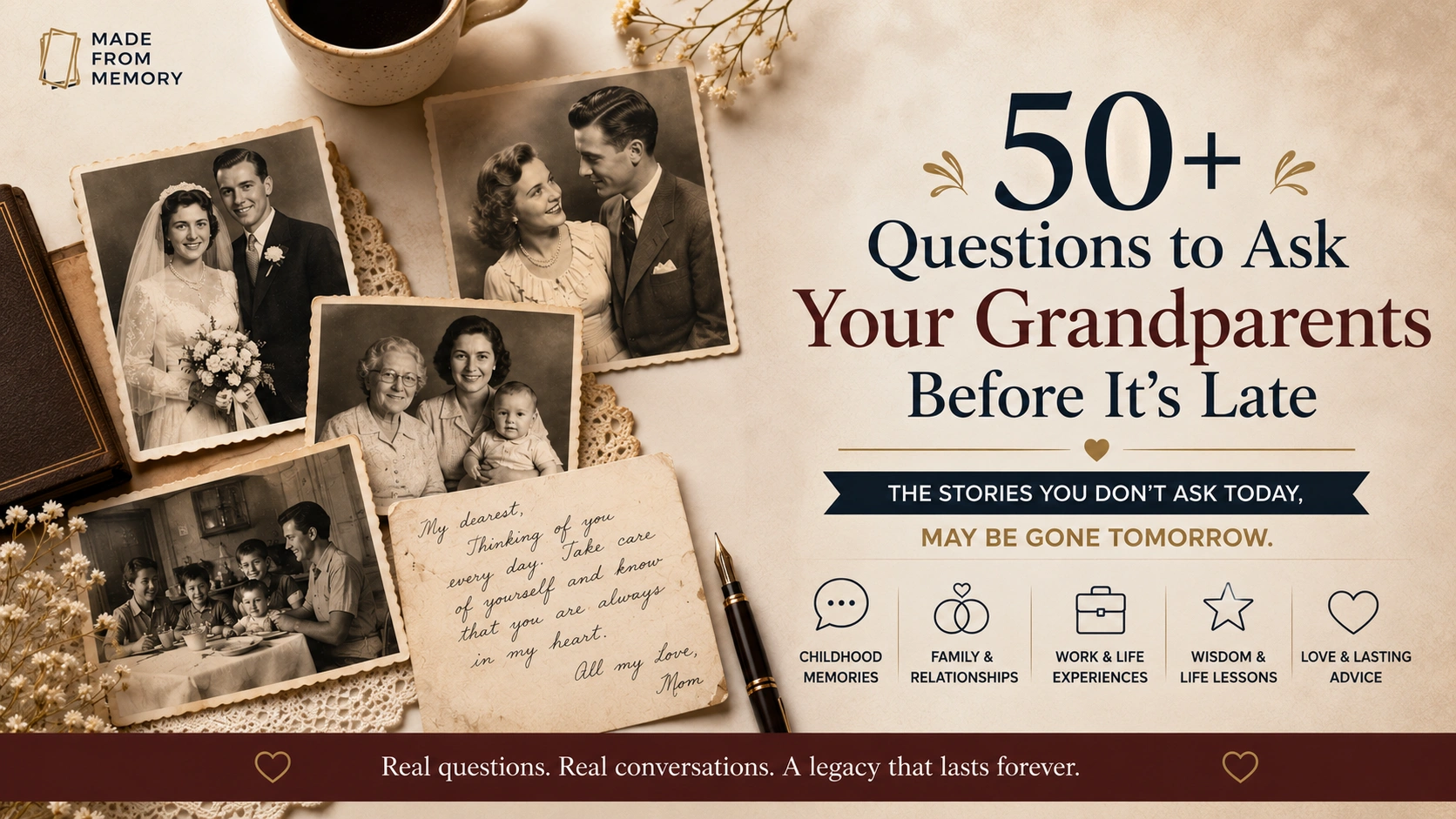
The best questions to ask your grandparents are the ones that draw out specific, sensory memories rather than general summaries. Instead of “What was your childhood like?” ask “What did your house smell like on Sunday mornings?” Instead of “How did you meet Grandma?” ask “What were you wearing the first time you saw her?” The fifty-plus questions in this guide are organized by life stage (childhood, adolescence, young adulthood, marriage and family, career, later years, wisdom and reflection) and are designed to be asked in unhurried conversations, ideally recorded on a phone with your grandparent’s permission, so that their voice and their stories can be preserved beyond their lifetime. The single most important thing is not which questions you ask. It is that you ask. The window closes faster than most families expect, and once it has closed, no amount of regret will reopen it.
This guide includes the questions themselves, advice on how to set up the conversation, what to do with the recordings afterward, and a gentle path forward for families whose grandparents are no longer here.
Why These Conversations Are So Urgent
There is a particular kind of grief that arrives the day after a grandparent dies. It is the grief of all the questions you never asked.
Sociologists who study family memory have a phrase for it: the “third generation gap.” A child knows their grandparents directly. A grandchild knows them mostly through the parent who connects them. But by the great-grandchild, the original person has often become a name on a family tree, a photograph on a wall, a few scattered stories repeated at holidays.
The window during which a family’s elder generation can speak for themselves is shorter than most families realize. The grandparents born in the 1930s, who lived through the Second World War and the post-war years, are mostly in their nineties now if they are still living. The grandparents born in the 1940s and 1950s, the generation that built much of the modern American middle class, are in their seventies and eighties. Time is moving.
This is not meant to alarm you. It is meant to gently invite you. If you have a living grandparent (or any elder family member: a great-aunt, a great-uncle, a family friend who has been in your life for decades) this year is the year to ask. Not next year. This year.
The questions below are a starting point. The conversations they lead to will be among the most important you ever have.
How to Set Up the Conversation
Before the questions, a few words about the conversation itself.
Ask Their Permission
Tell your grandparent in advance what you would like to do. “I would love to sit down with you and ask you some questions about your life. I want to record the conversation so that we have it forever. Would that be okay?” Most grandparents are deeply honored to be asked. A few will be hesitant. Take their lead.
Choose a Comfortable Setting
The kitchen table is the best place for these conversations. It is informal, comfortable, and has the right associations. Coffee or tea helps. Avoid recording in a noisy restaurant or in a room with significant background noise.
Use Two Recording Methods
Use your phone’s voice recorder as the primary recording. Use your phone’s video function as a secondary backup, propped up gently so it does not feel intrusive. If you can, also have a notebook and pen for jotting down notes during the conversation.
Plan for Multiple Sessions
Do not try to ask all the questions in one sitting. An hour or two at a time is plenty. Plan for multiple sessions over weeks or months. The conversations get richer with practice, and many of the best stories emerge in later sessions after the early ones have warmed your grandparent up.
Listen More Than You Talk
The biggest mistake interviewers make is interrupting. When your grandparent pauses, wait. Sometimes the pause is just a breath. Sometimes it is the beginning of a story they have never told anyone. Hold the silence. It will reward you.
Ask Follow-Up Questions
Every prepared question is a doorway. The real conversation lives behind the door. When your grandparent answers, listen for the detail that surprises you, and ask about it. “Wait, you said your father came home that day in a suit. What kind of suit was it?” The specifics are where the memories live.
The 50+ Questions, Organized by Life Stage
Childhood Questions (1 to 8)
These questions draw out the earliest, most sensory memories. They are often the easiest place to start.
1. What is your earliest memory?
Not a story they have been told. A memory they actually have. This single question often produces a thirty-minute story.
2. What did the house you grew up in smell like?
Sensory memory unlocks decades of detail. Bread baking. Pipe smoke. Lavender. Coal stove. The smell of the house often opens a door to everything inside it.
3. What was your favorite hiding spot as a child?
A child’s geography is intensely personal. The hiding spot reveals more about the family’s home and the child’s inner life than a tour of the rooms would.
4. Who was your best friend when you were eight years old, and what happened to them?
Childhood friendships are often the ones that get lost to time. This question recovers a name, a face, a story.
5. What was your favorite thing to eat as a child, and who made it?
Food memory is one of the most reliable forms of memory. The dish, the cook, the room where it was eaten: these come back together.
6. What was the bedtime ritual in your home?
Whether it was prayers, a story, a song, a kiss, or a kind of strict silence, the bedtime ritual reveals the texture of the family.
7. What was the first thing you remember being afraid of?
A surprising number of grandparents will remember this in vivid detail. The fear often connects to a specific event, place, or person.
8. What was your favorite game to play, and who did you play it with?
Games are how children build their first sense of relationships outside the family. The game and the playmates often appear together.
Family of Origin Questions (9 to 16)
These questions explore your grandparent’s parents and siblings, the family they were born into.
9. What was your mother like?
Open-ended on purpose. The answers vary enormously and reveal as much about the relationship as about the mother herself.
10. What was your father like?
Same approach. Listen for tone as well as content.
11. What was the hardest thing about your relationship with your parents?
This is a deeper question and may require a gentle setup. But it often produces the most honest and meaningful answers.
12. What is one thing your mother taught you that you have never forgotten?
This question produces wisdom your grandparent often did not know they remembered until you asked.
13. What is one thing your father taught you that you have never forgotten?
Same structure. The answers are often surprising and specific.
14. Who were your siblings, and what was your relationship like with each of them?
If your grandparent had multiple siblings, go through them one at a time. The relationships often differ dramatically.
15. What did your family eat on holidays?
Holiday food traditions are among the most carefully preserved family memories. Asking specifically about the food often unlocks the larger memory of the holidays themselves.
16. What is your favorite story about your grandparents?
This question reaches back two generations beyond yourself, and recovers stories that may otherwise be entirely lost.
Adolescence and Young Adulthood Questions (17 to 24)
These questions cover the teenage years and the transition into adulthood, often the most formative and least-documented period of a person’s life.
17. What was high school like for you?
The answer reveals not just the school but the era, the social class, the town, and the kind of young person your grandparent was.
18. What did you wear when you were sixteen?
A surprisingly evocative question. Clothing memory is sharp. The answer often comes with a story about where the clothes came from and what they meant.
19. What music did you love as a teenager?
Music memory is particularly reliable for older adults. Your grandparent will often be able to name specific songs, artists, and where they listened to them.
20. What was your first job, and how much did it pay?
This question is both practical and emotional. The first job often shaped your grandparent’s sense of independence and identity.
21. Who was your first crush?
Approach this gently, with humor. Many grandparents will give you a name and a story they have not thought about in fifty years.
22. What was the bravest thing you did as a young person?
A specific answer to an open-ended question. Listen for what your grandparent counts as brave: it reveals what they valued.
23. What was the biggest mistake you made when you were young?
Many grandparents have wisdom they want to share but no one has asked them how to share it. This question opens the door.
24. Did you serve in the military, and if so, what would you most want your grandchildren to understand about that time?
For grandparents who served, this question can be one of the most important you ever ask. It also requires patience: the answers may come slowly, in pieces, over multiple conversations.
Romance, Marriage, and Family Questions (25 to 32)
These questions explore the relationship that often defined your grandparent’s adult life.
25. How did you meet?
The classic question. Ask for specifics: where, when, what they were doing, what they were wearing.
26. What did you first notice about each other?
This goes deeper than “how did you meet.” Listen for what your grandparent says about the small details that drew them in.
27. What was your wedding day like?
The story of the wedding day reveals the era, the family dynamics, and the early years of the marriage. Ask about who was there and what people wore.
28. What was the hardest year of your marriage?
This is a brave question. Many grandparents will answer honestly if they trust you, and the answers often contain remarkable wisdom about long-term relationships.
29. What kept your marriage strong through the hardest times?
Pair this with the previous question. Together they create a powerful portrait of a long partnership.
30. What was it like to become a parent for the first time?
The story of holding their first child, of bringing the baby home, of those first sleepless weeks: these are often deeply moving.
31. What is one thing about parenting you got right, and one thing you wish you had done differently?
A direct question that produces direct, honest answers. The wisdom here is often something your grandparent has wanted to say for decades.
32. What is the most important thing you have learned about love?
Open-ended, designed for reflection. Save this one for later in the conversation, after the warm-up.
Career and Working Life Questions (33 to 38)
These questions cover the work that often took up most of your grandparent’s waking adult hours.
33. What did you most want to be when you were a child?
Often very different from what they actually became. The answer reveals what they imagined for themselves before life intervened.
34. What was your favorite job, and why?
Specific and answerable. Listen for the details: the people, the place, the work itself.
35. What was your hardest job, and what did you learn from it?
Pair this with the previous question. Together they reveal a working life.
36. What was your daily routine when you were in your thirties?
A surprisingly rich question. Your grandparent’s thirties were probably the busiest years of their life, and the routine reveals what they actually did all day.
37. Did you ever have to make a major career decision you were not sure about?
This produces stories that have shaped the whole family without anyone realizing it.
38. What did you learn about people from your work?
A reflective question. The answers are often deeply earned wisdom.
Larger Life Questions (39 to 46)
These questions explore the broader life your grandparent lived: the world events, the geography, the changes over time.
39. What was the most important world event of your lifetime?
Be open to what they say. Some grandparents will name a famous historical moment. Others will name something personal that happened to be world-changing for them.
40. What is the biggest change you have seen in your lifetime?
Often technological, but sometimes social, political, or personal. Listen for what they identify and what they have to say about it.
41. What is the most beautiful place you have ever been?
Easy to ask, surprisingly rich to answer. Ask for the specific moment that made the place beautiful.
42. What is something you regret not doing?
A gentle but important question. The answers often contain wisdom your grandparent wants you to carry forward.
43. What is something you are most proud of?
Pair this with the previous question. Together they create a balanced portrait.
44. What has surprised you most about life?
A philosophical question that produces philosophical answers. Often deeply moving.
45. What do you wish your own grandparents had told you?
This question creates a kind of recursion: your grandparent reflects on what they wish they had asked the people who came before them. Their answer often becomes a guide to what they wish to tell you.
46. What is the hardest thing you have ever had to do?
A serious question for a serious conversation. Be ready for an answer that takes you somewhere unexpected.
Wisdom and Reflection Questions (47 to 54)
These questions are for the end of the conversation, or for the last conversation in a series. They are reflective, philosophical, and gather the threads of everything that has come before.
47. What advice would you give to your eighteen-year-old self?
A classic question for a reason. The answers are often the wisdom of a whole life.
48. What advice would you give to me, knowing what you know now?
This personalizes the previous question. Your grandparent’s answer is something to write down and keep.
49. What do you hope your grandchildren will remember about you?
This question allows your grandparent to shape their own legacy. The answer often becomes part of how the family remembers them.
50. What do you believe about what happens when we die?
Approach with reverence. Some grandparents will have a clear religious answer. Others will be more uncertain. Either way, the answer reveals something about how they have lived.
51. What has made you the happiest in your life?
Often a surprisingly small answer. The grandchildren. A specific morning. A long-ago summer. Listen carefully.
52. What has caused you the most pain in your life?
The companion to the previous question. Together they create a portrait of a whole life.
53. What do you most want to say to the people you love but have not said?
This question gives your grandparent a chance to say something they may have been carrying for a long time. Be ready to receive it.
54. If you could leave us with one message, what would it be?
The final question. Often the most important. Save it for the very last conversation, when the relationship between you has been deepened by everything that came before.
Tips for Recording the Conversations Well
The questions are only half the work. The other half is preserving the conversations so that they outlast everyone in the room.
Use Your Phone’s Voice Memo
Modern smartphones have excellent voice recording quality. The voice memo app on iPhone, or the equivalent on Android, is more than sufficient for archival recording. Set the recording quality to high if you have the option. Make sure your phone has plenty of storage and battery.
Add a Backup Recorder
If you have access to a second device, run a backup recording. The night you discover your primary recording failed is one of the worst nights a family memory keeper can have. A second phone, a tablet, or a small dedicated voice recorder all work.
Consider Video, Even If You Plan to Use Only Audio
Position your phone so it captures video as well as audio. You will treasure being able to see your grandparent talking, even if you intended only an audio archive. Set the phone on a stack of books or in a small phone holder so it is not awkward.
Take Notes During the Conversation
A notebook open on the table lets you jot down names, dates, places, and follow-up questions. The notes also become a guide when you later transcribe or summarize the recordings.
Transcribe (Or At Least Index) the Recordings
After each session, listen back and either transcribe key passages or create an index (“0:00 to 14:30: childhood home and her parents. 14:30 to 32:00: school years. 32:00 to end: her sister”). Without an index, hours of recordings become difficult to navigate. There are AI transcription services that can do this quickly and inexpensively, but check the accuracy on names and specific words.
Save the Recordings in Multiple Places
This is critical. A recording that exists only on one phone is one accident away from being lost. Upload to a cloud account. Save to your computer. Save to an external hard drive. Send a copy to another family member.
Consider Sharing Selected Excerpts With the Family
Many families never share the recordings beyond the person who made them. This is a mistake. Send short excerpts to siblings, cousins, and other grandchildren. Play favorite clips at family gatherings. The recordings only do their full work when the rest of the family can also hear the voice.
What to Do With the Stories Afterward
Recording the conversations is the first step. Building something from them is the second.
A Simple Family Audio Archive
The minimum version is a folder on your computer or in the cloud, with the recordings labeled by date and topic, backed up in multiple locations. This is sufficient. Many families never go beyond this, and the recordings remain accessible for generations.
A Written Document of Their Stories
Some families take the conversations and turn them into a written document. Not a full biography (which is overwhelming) but a collection of the best stories, written in your grandparent’s own words where possible, edited gently for readability. Forty to eighty pages is a common length. Some families have this printed and bound, with photographs included, as a family book.
A Photo and Story Combination
For families who also have photographs of their grandparent across the decades, pairing the stories with the images creates something deeply meaningful. The photograph of your grandmother at sixteen, paired with her recorded story of her sixteenth year, becomes a kind of personal time machine.
A Tribute Video Built From Photographs and Their Voice
For some families, the most powerful next step is a photographic tribute that incorporates short clips of the grandparent’s own voice. Imagine watching a tribute video, set to gentle music, with photographs of your grandfather across his life, and hearing his own voice, taken from one of these conversations, tell a story over the images. This is a form of family preservation that did not really exist twenty years ago, and that more and more families are now exploring.
Our overview of how animation tells your story discusses how these elements can be brought together. For families who would like to incorporate recorded voice into a tribute, our team handles this carefully and respectfully. Our pricing is straightforward: a single animated photograph clip is twenty dollars, a full tribute film of up to 25 photographs paired with music is three hundred dollars, and an extended tribute of up to 50 photographs is five hundred dollars. Every project is covered by our 100% Satisfaction Promise. You can view our memorial video services for more detail.
What If Your Grandparents Are Already Gone?
For families whose grandparents are no longer here, this article may bring a particular kind of ache. The window for the direct conversation has closed.
But not everything is lost.
If your parents knew your grandparents well, your parents can answer many of the same questions on their behalf. The answers will be filtered through your parent’s perspective, but they are still genuine family memory. Ask your parents the questions you would have asked your grandparents.
Letters, diaries, and other written materials sometimes survive. If you have access to old family papers, read them. Some grandparents wrote far more than their families realized.
Voicemails, home video footage, and other recordings sometimes exist. Search through old phones, hard drives, and tapes. Even a thirty-second audio clip of a grandparent’s voice is precious.
Older relatives (great-aunts, great-uncles, family friends) often remember your grandparents in ways your parents do not. Reach out. Ask. Many of these older relatives will be honored to be asked.
And finally: even without direct recordings, you can preserve what is known. Write down what you remember. Write down what your parents remember. Build the family archive from the materials that exist. Future generations will thank you for whatever you can save, even if it is incomplete.
For families looking to preserve and honor the memory of grandparents who have already passed, our piece on how animation preserves family history covers how photographs (even old, fragile, or limited ones) can be brought into a meaningful tribute that becomes part of how the family carries them forward.
Common Questions About Interviewing Grandparents
How long should each interview session be?
Most older adults can engage meaningfully in conversation for sixty to ninety minutes before fatigue sets in. Plan for that range. Schedule multiple sessions rather than one long marathon.
What if my grandparent does not want to talk about something?
Respect it. There may be parts of their life (a difficult childhood, a lost relationship, a painful war experience, a complicated grief) that they have chosen not to revisit. Honor that choice. Move to a different question.
What if my grandparent’s memory is failing?
Adjust the questions. Older adults with memory challenges often remember the distant past more vividly than the recent past. Focus on childhood, young adulthood, and early married life. Avoid questions that test memory (“What did we do last Thanksgiving?”). Focus on questions that invite stories.
What if I am nervous about asking?
Most grandchildren are. The conversation is unfamiliar, and you are afraid of saying the wrong thing or making your grandparent emotional. Three thoughts: the awkwardness fades after about ten minutes. Your grandparent is almost certainly more honored than uncomfortable. And if you cry, or they cry, that is part of what the conversation is for.
Should I tell my grandparent the questions in advance?
It is a personal choice. Telling them in advance allows them to think. Not telling them produces more spontaneous answers. A middle path: send them three or four sample questions a few days before, so they can start thinking, but save the bulk of the questions for the actual conversation.
What is the right age to start asking grandparents these questions?
There is no right age. A child of ten can ask a meaningful question of a grandparent. An adult of fifty can ask one with even more depth. The right age is the age you are now. The wrong age is the age after they are gone.
Should other family members be present for the interview?
Generally no. A one-on-one conversation produces deeper, more honest answers. Older grandparents sometimes hold back in front of certain family members. If you want to include other relatives, do separate one-on-one sessions and then combine the recordings later.
What if my grandparent and I do not have a close relationship?
These conversations can build the relationship even as they preserve it. Some of the most meaningful grandparent interviews happen between grandchildren and grandparents who were not previously close. The questions create a structure that makes the conversation possible.
Should I ask about hard topics like death and grief?
If the relationship is strong enough and your grandparent seems willing, yes. Many older adults have thought deeply about death and want to say something about it to someone who will listen. Approach with reverence, and let them lead.
What is the single most important question to ask?
If you could only ask one question, ask this: “What do you most want me to remember about you?” The answer is your grandparent’s own self-portrait, in their own words, which is worth more than anything you can compose on your own behalf later.
A Quiet Closing
The questions in this guide are a beginning, not an ending. The real work of preserving your grandparents’ stories is the work of asking, listening, recording, and returning. It is the work of choosing, in the middle of a busy life, to sit down with someone you love and to invite them to tell you who they have been.
It is also one of the most quietly important things you will ever do.
The stories your grandparents tell you will outlast them. Their voices, recorded on your phone, will play for great-grandchildren they will never meet. The wisdom in their answers will shape how your family thinks about the world for generations.
Start the conversation this week. Not next month. This week.
And if, in time, you would like to bring those stories together with photographs of your grandparents (into a tribute video that gathers their voice, their face, and their life into one place to share with the family) our team would be honored to help. You can view our memorial video services, browse our tribute video portfolio, or reach out through our contact page for a gentle conversation about what would suit your family.
Leave a Reply