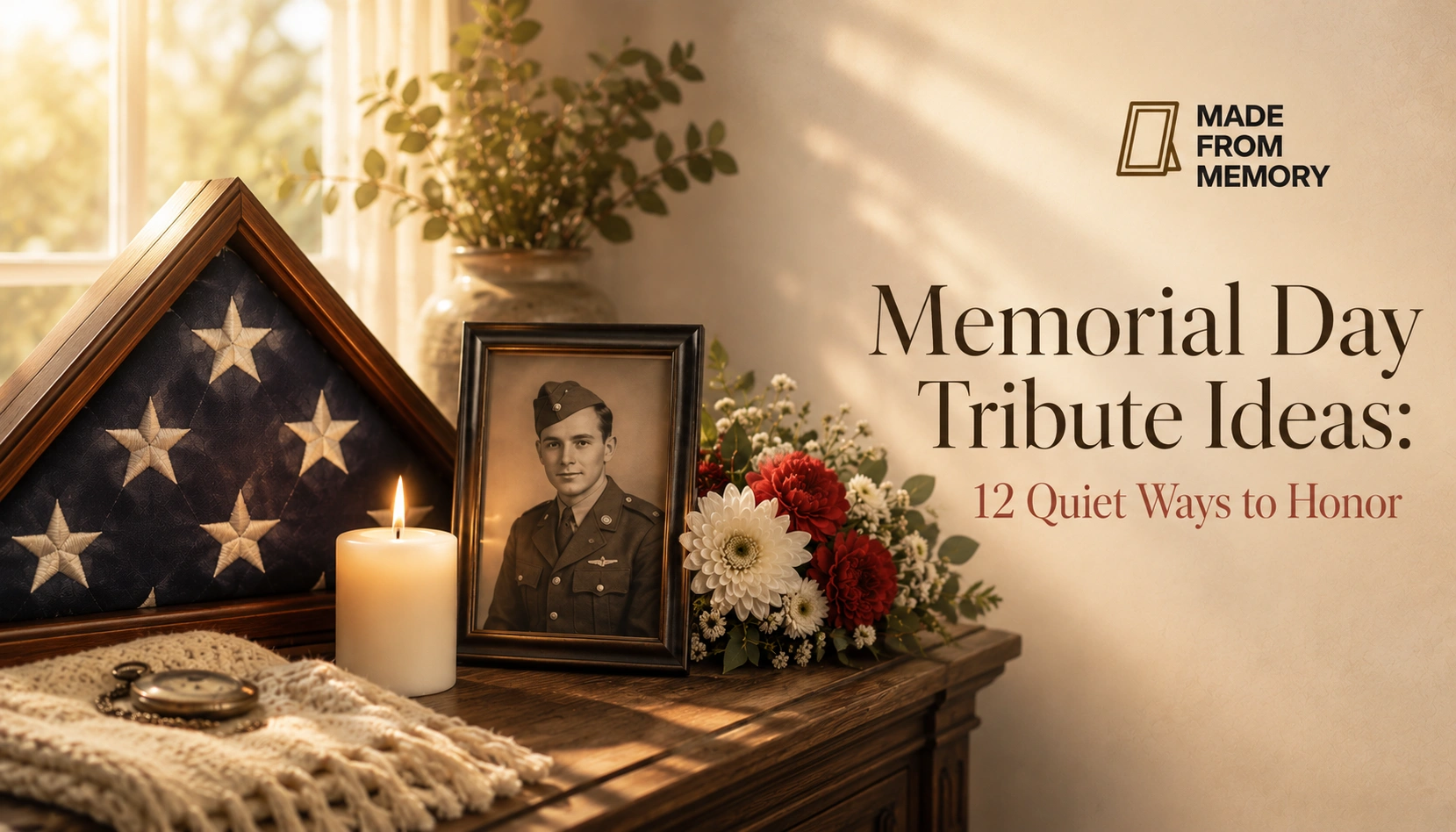
The most meaningful Memorial Day tribute ideas are usually the quietest ones: lighting a candle in the early morning, sharing a story over breakfast, displaying a folded flag, watching an animated photograph of a loved one in uniform, or simply observing the National Moment of Remembrance at 3:00 p.m. local time. Memorial Day is not a “happy” holiday in the traditional sense. It is a day set aside to honor American service members who died in the line of duty, and the best tributes are the ones that feel personal, gentle, and grounded in the family’s own memory of the people they lost.
This guide offers twelve home-based ways to honor fallen service members, with a particular focus on Gold Star families, families with veterans in declining health, and families who are still actively grieving. You will also find guidance on how to talk to children about Memorial Day, how to balance reverence with family togetherness, and how to create a meaningful tribute even if the loss happened generations ago.
Why Memorial Day Asks Something Different of Us
Most American holidays ask us to celebrate. Memorial Day asks us to remember.
That distinction matters. For families who have lost a service member (whether last year in a recent conflict, or generations ago in a war whose name has faded from the front pages) Memorial Day is not a long weekend. It is a day that holds a particular kind of ache. The barbecues and parades, while a meaningful part of how America gathers, can sometimes feel out of step with what the day was originally for.
This is not a criticism of celebration. It is an acknowledgment that for many families, Memorial Day is observed most fully at home, in private, with the people who knew the person being remembered. The quiet rituals are often the deepest ones. A folded flag on a side table. A photograph of a young man in uniform set in the morning sunlight. A single bell struck at 3:00 p.m. A child being told, for the first time, about the great-uncle they will never meet.
These are the tributes that hold up across years. These are the ones we will focus on here.
A Brief, Respectful History of Memorial Day
Memorial Day began as Decoration Day, in the years immediately after the American Civil War. Communities, both North and South, gathered to decorate the graves of fallen soldiers with flowers, flags, and small handmade tokens. The first widely recognized observance took place on May 30, 1868, and the tradition spread quickly. By the late nineteenth century, families across the country had developed local rituals: cemetery visits, communal meals, the laying of small American flags at the graves of veterans.
In 1971, Congress officially designated the last Monday in May as Memorial Day, a federal holiday honoring American service members who died in service to the country. Importantly, Memorial Day is distinct from Veterans Day (which honors all who served, living or deceased) and from Armed Forces Day (which honors those currently serving). On Memorial Day, the specific intention is to honor those who gave their lives.
Knowing this history helps shape the tone of family observance. Memorial Day is not “thank you for your service.” It is “we will not forget you.”
Who Is This Guide For?
This guide was written with several kinds of families in mind.
It is for Gold Star families: those who have lost a service member in the line of duty. The Gold Star designation has been a symbol of family sacrifice since the First World War, when families displayed gold stars in their windows to indicate a service member lost. For these families, Memorial Day is not a holiday at all. It is an anniversary that comes every year.
It is for families with veterans in their lineage who never spoke much about the war, but whose service shaped who they were. The grandfather who came back from Vietnam and never quite came all the way home. The great-grandmother who served as a nurse in the Pacific. The cousin no one talks about, but whose photograph still hangs in the hallway.
It is for families with a recent loss in active duty. The wounds are still fresh, and the holiday may be approaching for the first time.
And it is for families who simply want to teach their children what Memorial Day is, and who want to do something meaningful at home rather than only attending a parade.
There is room in this day for all of you.
12 Quiet Memorial Day Tribute Ideas Families Can Do At Home
1. Observe the National Moment of Remembrance at 3:00 P.M.
The simplest, most universally meaningful Memorial Day tribute is also the one most Americans have never heard of. In 2000, Congress established the National Moment of Remembrance, a one-minute pause at 3:00 p.m. local time on Memorial Day, to honor all who died in service to the country.
To observe it at home: at 3:00 p.m., pause whatever you are doing. Put down your phone. Step outside if you can. Stand quietly. If you are with family, hold hands, or place a hand on a child’s shoulder, or simply sit together in silence. Sixty seconds. That is all it takes. It is a remarkable thing to teach a child: that an entire country, at one moment, chose to be quiet together.
2. Create a Memorial Display in a Quiet Corner of Your Home
A small display on a side table, mantel, or shelf becomes a focal point for the day. Common elements include: a photograph of the service member, a folded flag (a triangular case is traditional, but any folded flag with respect is appropriate), a small candle, any medals or insignia that belonged to them, a handwritten note or letter, and perhaps a small bouquet of flowers in red, white, and blue.
The display does not need to be elaborate. The point is intentionality. For one day, this corner of your home becomes a place where the family remembers, together. Many families set up the display the night before and remove it the day after, marking the day as something separate from ordinary life.
3. Share Stories Over a Family Meal
A Memorial Day meal at home (whether elaborate or simple) can become a tribute when the conversation turns deliberate. Before the meal begins, light a candle and ask each person at the table to share one memory or one thing they were told about the family member being honored. Children may not have direct memories. That is fine. They can share what they have heard, or ask a question.
This is one of the most powerful ways to keep a fallen service member present in a family across generations. The grandchild who never met their great-grandfather, but who can tell the story of his last leave home, has been given a real inheritance.
4. Light a Candle in the Morning
A morning candle, lit quietly before the rest of the house wakes, is a tribute that many Gold Star families practice every year. The candle burns through the day, marking the home as a place of remembrance. There is no formal ritual required. The act itself is the prayer.
If you have a particular candle that was meaningful to the person you are honoring (a scent they wore, a color they loved, a holiday candle from a tradition they kept) using that specific candle deepens the tribute.
5. Visit a Loved One’s Resting Place, or Send a Stand-In Tribute
If you live close to the cemetery, visiting on Memorial Day morning is one of the oldest American traditions. Bring a small American flag (these are often available through veterans’ organizations in the weeks leading up to Memorial Day) and place it gently at the grave. Bring fresh flowers if you can.
If you cannot travel to the resting place, many cemeteries now offer “stand-in” services where staff or volunteers will place a flag and flowers on your behalf. Some Gold Star organizations also coordinate national tribute placements. If you are unable to visit in person, this is a meaningful alternative.
6. Display a Photograph in Soft Motion
For many families in recent years, a quiet new tradition has emerged: rather than only setting out a still photograph, families now sometimes display a gently animated photograph of their loved one in uniform. The image (a young man in his service photo, a great-grandmother in her nurse’s uniform, a sibling on the day they shipped out) is brought into soft, respectful motion: a slight smile, a small turn of the head, a sense of breath.
This is not a recreation of the person. It is an artistic interpretation, a way of restoring presence to a still image, particularly for younger family members who never met the person. When done with care by human creators (not handed off to a faceless algorithm) it can become one of the most touching elements of a family’s Memorial Day. Our overview of how animated memories preserve family history walks through this thoughtfully for families considering it for the first time.
7. Write a Letter to the Person You Lost
There is something about writing that other forms of remembrance cannot quite reach. On Memorial Day morning, set aside thirty minutes. Sit with a piece of paper. Write a letter to the person you lost.
Tell them what has changed in the family. Tell them about the grandchildren they never met, the milestones they missed, the way you still think of them. The letter does not need to be shared with anyone. Many families keep these letters in a small wooden box, accumulating one per Memorial Day for years. After a decade, the box itself becomes an heirloom.
8. Read or Recite Something Meaningful
For families with a religious or literary tradition, reading something aloud on Memorial Day morning grounds the day in language larger than the moment. Common choices include the Gettysburg Address, “In Flanders Fields” by John McCrae, the prayer of remembrance from your family’s faith tradition, a passage from a letter the service member wrote home, or even a favorite poem that the person loved.
Reading aloud in a quiet house, with a candle burning, is a form of attention that says: this matters enough to slow down for.
9. Teach the Children Something Specific About the Person
Generic patriotism is not a substitute for specific memory. If you have children in the home, choose one specific story about the person you are honoring and tell it to them on Memorial Day. Not the abstract heroism. The specific detail. The way they always whistled while they shaved. The food they ordered every Friday night. The joke they told over and over that wasn’t quite funny but everyone laughed at anyway.
Children remember details. They forget abstractions. The specific story, told well, becomes part of who they understand themselves to be.
10. Cook Their Favorite Meal
Food is memory. If you know what the person you are honoring loved to eat (or loved to cook) preparing that meal on Memorial Day becomes a quiet, deeply rooted form of tribute. The grandfather who always grilled on holidays. The aunt whose macaroni and cheese was famous in the family. The brother who never met a barbecue he didn’t like.
Cooking the meal, with the family helping, becomes a way of physically participating in the person’s continued presence. For families with younger children, this is often the most accessible form of memorial: the child who helped grandma make the cornbread on Memorial Day will remember that long after they forget the specifics of any speech.
11. Donate or Volunteer in Their Name
Many families choose to mark Memorial Day with an act of service. This can be a donation to a veterans’ organization (the Wounded Warrior Project, the Gary Sinise Foundation, Tragedy Assistance Program for Survivors, the USO, or a smaller local veterans’ group). It can be a few hours of volunteer time at a veterans’ home, hospital, or cemetery. It can be a meal prepared for a neighbor who is also grieving.
The principle is that honoring those who served is most fully done by serving others. A small donation in the person’s name, made every Memorial Day, becomes a sustained form of tribute.
12. Create a Long-Form Tribute the Whole Family Can Keep
For families who want to do something more substantial (especially in milestone years, like a tenth or twenty-fifth anniversary of a loss) a longer tribute film built from family photographs can become a centerpiece of Memorial Day for years to come. Played quietly during a family gathering, sent to relatives who could not attend, or simply watched alone in the morning, a gentle photographic tribute set to music does something a single photograph cannot.
This is the work we are honored to do at Made From Memory. Many of the tributes we create for Memorial Day are commissioned by families months in advance, allowing time for careful curation of photographs, conversations with multiple family members, and a finished result that the entire family can hold. For families considering this kind of project, our piece on the evolution of photo animation walks through how this art form has grown into a meaningful family tribute.
How to Talk to Children About Memorial Day
Memorial Day can be confusing for children. They see flags, parades, picnics, and a long weekend. They may not understand why the adults around them seem quieter or sadder than usual.
A few gentle principles for talking with children.
Be specific. Children understand specific people better than abstract groups. “Memorial Day is the day we remember Uncle James, who was a soldier and died helping his friends” is more meaningful than “Memorial Day is when we remember the troops.”
Be honest. Children can handle the truth of death, especially when it is delivered with calm and warmth. Avoid euphemisms that confuse (“he was lost” can be taken literally). Use the word “died” gently and clearly.
Show, do not just tell. Bring the child to the memorial display. Let them help light the candle. Let them place the small flag. Children participate in meaning through their hands.
Invite their questions. Some questions may surprise you. Some may be repeated for years. Answer each one as if it is being asked for the first time.
Connect it to love. Memorial Day, at the heart, is about love that did not stop because the person died. That is a concept even very young children can grasp.
Honoring Gold Star Families: A Note of Particular Care
If you are part of a Gold Star family, much of what is written above probably feels obvious. You have lived this day. You know it.
What you may need from a guide like this is not new ideas. It is permission. Permission to do whatever you need to do this Memorial Day. Permission to skip the family gathering if it feels too much. Permission to drive to the cemetery alone before sunrise. Permission to spend the day with the photograph and the letter and the candle, and not to explain yourself to anyone.
A few additional thoughts that may be useful.
The Tragedy Assistance Program for Survivors (TAPS) and the Gold Star Mothers and Gold Star Wives organizations offer Memorial Day events specifically for families like yours. Some are in-person, others virtual. If you have never connected with these groups, this may be the year.
Children of fallen service members often carry their grief quietly because they sense the adults around them are also grieving. A direct, gentle conversation with these children on Memorial Day (acknowledging their loss is real, and that their parent is still their parent, even gone) is one of the most important things a family can do.
The first Memorial Day after a loss is often the hardest. The fifth and the tenth can be unexpectedly difficult too. Grief does not follow a schedule. Whatever you feel this year is right.
If you are considering creating a tribute that honors the service member specifically (a film built from their photographs across their life, set to music they loved, suitable for sharing with extended family and future generations) you can reach out to our team for a gentle, unhurried conversation about what is possible.
Memorial Day Tributes for Families Far From the Resting Place
Many American families today live thousands of miles from where their fallen service members are buried. Military families move. Cemeteries are often near training bases or in the service member’s home state, far from where the surviving family eventually settled. For these families, the question of how to observe Memorial Day at home is especially real.
Some ideas for distant families.
Create a “memorial-in-place” at home: the display described in tribute idea two becomes the cemetery you cannot easily visit. The folded flag, the candle, the photograph: these constitute a sacred space wherever you are.
Use video calls intentionally. If extended family members can visit the resting place, ask them to walk you through it on video. Pause when they reach the marker. Read the inscription aloud. The experience of being present at a grave through a phone screen is imperfect, but it is also more present than absence.
Plan one in-person visit per generation. Some families establish a tradition of visiting the resting place once every five or ten years, often during a family reunion. Knowing that visit is coming gives shape to the years in between.
The Quiet Tributes That Last Across Generations
Memorial Day tributes do not have to be elaborate to be enduring. The most lasting traditions are usually the simplest: the same candle, lit on the same morning, every year, for forty years. The same story, told at the same table. The same flag, placed by the same hands.
What makes these traditions powerful is not their content but their repetition. When a child grows up watching their parent observe Memorial Day in a particular way, they absorb the meaning without being lectured into it. By the time that child is an adult, the tradition has become part of who they are, and they pass it forward without thinking about it.
This is how memory survives in families: through the small, repeatable, unwritten rituals that the next generation observes, copies, and eventually carries.
How Made From Memory Honors Service Members and Veterans
Many of the tributes we are most honored to create are for military families. Whether the loss happened last year in active duty, or two generations ago in a conflict that has faded from public conversation, we approach each project with the same care.
Every project begins with the family’s own photographs, the family’s own story, and a conversation about what feels right. Our human creators handle every step of the curation, using animation tools to assist (never to replace) the careful, respectful artistry. We are very clear about what our work is and is not: it is a gentle artistic interpretation designed to evoke emotion and presence, not a literal or historical recreation. Our behind-the-scenes look at the process explains how every tribute is shaped by a real person’s care.
Our pricing is straightforward. A single animated photograph clip is twenty dollars. A full tribute film of up to twenty-five photographs, paired with music, is three hundred dollars. An extended tribute of up to fifty photographs is five hundred dollars. Most projects are delivered within five to ten business days after all materials are received, and we offer expedited delivery for families with firm memorial service or anniversary dates. Every project is covered by our 100% Satisfaction Promise: if you are not happy with the result, we revise until you are, and if you remain unsatisfied, we refund in full.
For families who would like to see examples of past military and memorial tributes, our tribute video portfolio offers a gentle sense of what is possible. For families who want to understand the full process and pricing before reaching out, our memorial video services page covers each step in detail.
Frequently Asked Questions About Memorial Day Tribute Ideas
What is the most appropriate way to honor a fallen service member at home?
The most appropriate way is the one that reflects the specific person you are honoring. A photograph displayed with care, a candle lit in the morning, a story told to a child, the National Moment of Remembrance observed at 3:00 p.m. Memorial Day tributes are deeply personal. There is no universal “right” way, only the way that feels true to your family.
Is it disrespectful to enjoy a barbecue or family gathering on Memorial Day?
No. Memorial Day has always included both remembrance and gathering. The original Decoration Day observances often ended with communal meals. What matters is making space for the remembrance alongside the celebration: a moment of silence before the meal, a story shared, a photograph displayed. Joy and grief can occupy the same day, and often do.
Should I say “Happy Memorial Day”?
This is a personal choice, and reasonable people disagree. Many Gold Star families and veterans prefer phrases like “Have a meaningful Memorial Day” or simply “Thinking of those we have lost today.” If in doubt, choose words that acknowledge the day’s purpose. Most people will appreciate the care.
How do I include children in Memorial Day without overwhelming them?
Start small. One specific story. One small task (placing a flag, lighting a candle, putting a photograph on the table). One question. Children process meaning through repetition and participation, not through long explanations.
What is the difference between Memorial Day and Veterans Day?
Memorial Day honors American service members who died in service to the country. Veterans Day honors all who have served in the United States Armed Forces, living and deceased. Both are important, but Memorial Day’s tone is specifically one of remembrance for those lost.
How can a family honor a service member who died decades ago and is no longer in living memory?
By bringing them back into living memory. Share their photographs with children who never met them. Tell their stories at the family table. Display their name and image somewhere visible. Consider creating a longer tribute that gathers what is known about them into one shareable place. Family history is preserved by being practiced.
Is creating an animated tribute video appropriate for Memorial Day?
Many families find it deeply meaningful, when done with care. A gentle, respectful photographic tribute that honors the person with their own images, set to music they loved or that has meaning to the family, can become a centerpiece of Memorial Day observance for years. The key word is “respectful.” This is not entertainment. It is remembrance in motion.
Can a Memorial Day tribute include family members who served but did not die in combat?
Memorial Day is specifically for those who died in service to the country. However, many families use the weekend as a broader time of military remembrance, honoring all family members who served. Both approaches are meaningful. If you choose to broaden the day, consider keeping the actual Memorial Day Monday focused on those who died in service, and using the weekend hours for the wider family military history.
A Closing Word
Memorial Day is a day that asks something specific of us: to hold the weight of what others gave on our behalf, and to keep their names alive in the rooms where they are still loved.
Whatever you do this Memorial Day (a candle in the morning, a flag at a grave, a story told to a child, a tribute film played quietly in a living room) please know that the quiet tributes are the ones that last. The world will not see most of them. But the people you are honoring would.
That is enough. That has always been enough.
If we can help your family create a tribute that holds a service member or veteran in motion, our transparent pricing page lays out every option clearly, with no surprises and our 100% Satisfaction Promise on every project.
Leave a Reply