
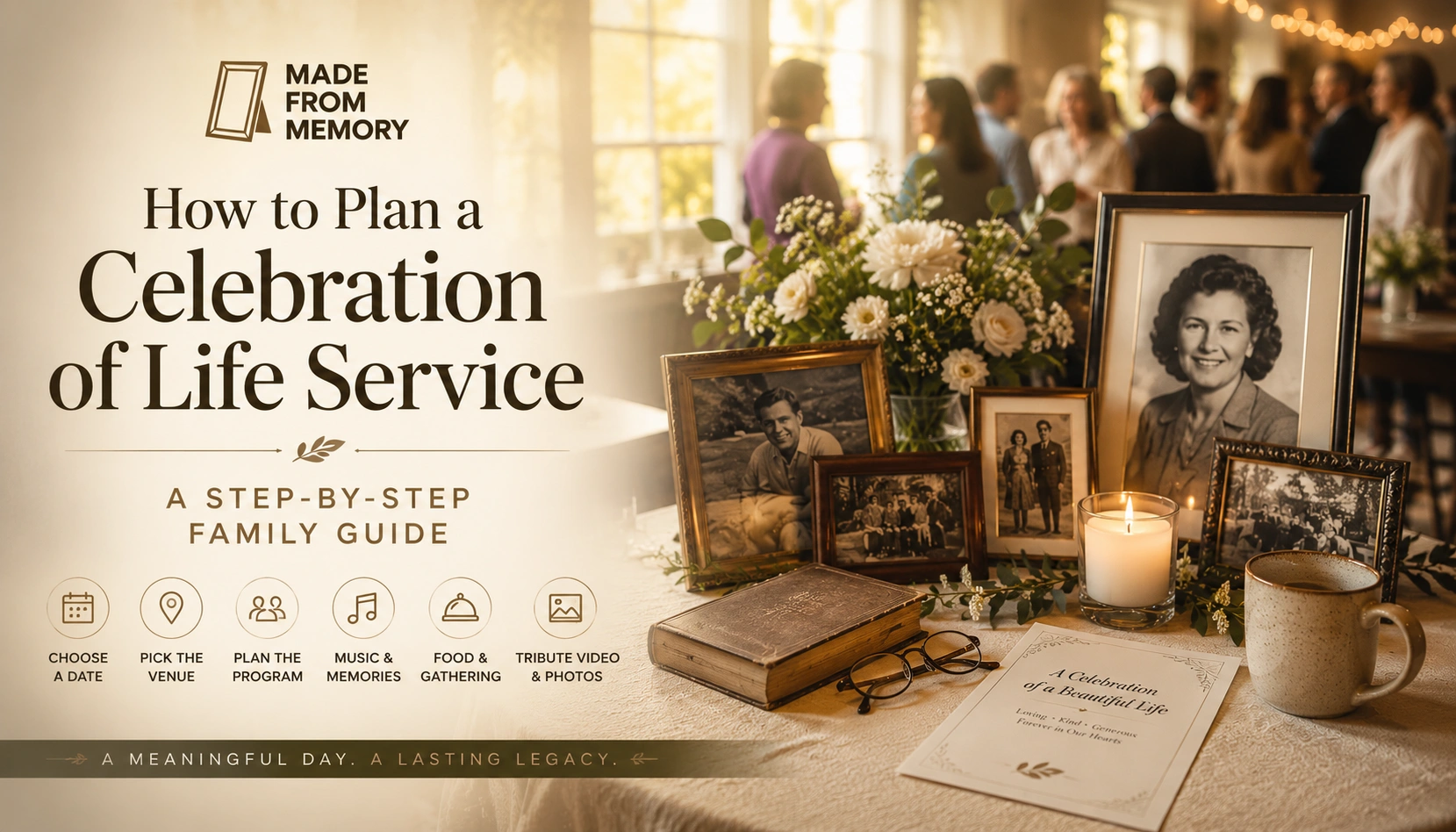
To plan a celebration of life, families usually move through eight stages: choose a date that allows time without rushing the grief, pick a venue that suits the person’s personality (a backyard, a community room, a restaurant, a park, or a faith setting), decide on a guest list, build a simple program that mixes speakers and quieter moments, select music that reflects who the person was, plan food and drinks appropriate to the gathering, include a visual centerpiece such as a memory table and a tribute video, and send clear invitations. Unlike a traditional funeral, a celebration of life can take place weeks or months after a death, can be held almost anywhere, and is shaped entirely by the family’s understanding of how the person they loved would have wanted to be remembered.
This step-by-step guide walks through every decision a family typically faces when planning a celebration of life, with realistic timelines, sample programs, and gentle guidance for the most common questions. It is written for families who are planning their first one, often during one of the hardest seasons of their lives, and who want a clear path through the choices ahead.
What a Celebration of Life Is (And How It Differs From a Traditional Funeral)
A celebration of life is a gathering held in memory of a loved one who has died, designed to honor who they were rather than to mark their passing in a strictly religious or formal sense. Compared to a traditional funeral, a celebration of life is usually less structured, more personal, often longer, and frequently held outside of a funeral home or place of worship.
The key practical differences:
A traditional funeral is usually held within a few days of the death, often involves a casket or urn present, follows a religious or denominational structure, and ends with burial or interment.
A celebration of life is held days, weeks, or even months after the death. It rarely has a casket present (the body is often already buried, cremated, or otherwise tended to). It can be religious, secular, or a blend. It can happen at a home, a park, a restaurant, a community center, a beach, a vineyard, or any place that meant something to the person.
Many families today choose to do both: a smaller private burial or memorial service close to the death, and a larger celebration of life held later when out-of-town family can travel, when the body is no longer involved, and when the family has had time to plan something more reflective of the person’s personality.
There is no single “right” form. The right celebration of life is the one that feels like the person it honors.
Why the Format Has Grown So Popular
In the last twenty years, celebrations of life have become one of the most common forms of memorial gathering in the United States. Several factors have driven the shift.
Religious affiliation has declined. Many families no longer have a default faith tradition to draw on for funeral structure, and a more personal, flexible format makes sense.
Cremation rates have risen sharply. With cremation, the urgency of a traditional funeral within a few days of death is reduced, and families can take time to plan something meaningful.
People want personalization. A generic funeral does not always reflect the person being remembered. A celebration of life lets families build something that genuinely feels like the person.
Grief is being treated more openly. The older convention of “the funeral is the ending” has softened. Many families now hold the celebration weeks or months later, when they have had time to grieve enough to be present at the gathering.
Whatever brought your family to consider this format, the planning principles are the same: be true to the person, be gentle with each other, and let the small details carry the love.
A Realistic Timeline for Planning
Here is a typical timeline for a celebration of life held one to three months after a death.
Week One After the Death
Take a breath. Do nothing celebration-of-life related yet (unless you have already committed to a date). The first week is for tending to immediate practicalities (paperwork, immediate family, funeral home if relevant) and for grief. Planning a celebration in the first few days is possible but often leads to choices that are regretted later.
Week Two to Three
Begin gentle planning. Decide approximately when the celebration will be (a season, a month, a target date). Talk with the immediate family about what kind of gathering would suit the person. Start a rough guest list. Begin gathering photographs for any visual elements.
Four to Eight Weeks Before
Confirm the venue. Send save-the-dates if needed. Begin contacting potential speakers. Choose music. If you plan to include a tribute video, this is the time to start. A professional tribute typically takes one to two weeks once materials are received, and a custom film at our memorial video services is usually delivered within five to ten business days.
Two to Four Weeks Before
Send formal invitations or detailed announcements. Confirm food and drink arrangements. Finalize the program order. Confirm speakers and the order in which they will speak. Order any printed materials (programs, memorial cards, photographs).
One Week Before
Confirm every detail with the venue. Test the audio and video equipment if you can. Print the program and any keepsakes. Make sure all out-of-town family has clear information.
The Day Of
Arrive early. Set up the memory table. Test the tribute video. Have a designated “greeter” so that the immediate family is not on the door. Build in quiet moments for yourself across the day.
This timeline assumes a one-to-three-month planning window. If the celebration is sooner, compress proportionally. If it is later (and many are held at the six-month or one-year mark), spread proportionally.
Step One: Choose the Date
The date is the foundation. Everything else flows from it.
Consider these factors. When can immediate family realistically gather? Some families have grandchildren in college, siblings overseas, or aging parents who need notice. When will the venue be available? When will close friends be able to attend? Are there meaningful dates (the person’s birthday, an anniversary, a holiday they loved) that would make the gathering more meaningful?
Avoid the temptation to schedule the celebration too soon. The most common regret families share is that they planned the celebration before they had emotionally caught up to the reality of the loss, and the event passed in a haze. Six weeks after the death is a common minimum. Two to six months is a common window.
Avoid the opposite extreme too. A celebration held a year or more after the death can feel disconnected from the grief. The “right” timing is the timing that lets the family be present at the gathering.
Step Two: Choose the Venue
The venue says more than people realize. A celebration of life held in a stuffy banquet hall feels different from one held in a backyard. Match the venue to the person.
Common Venue Options
The family home or the home of a close relative. Intimate, deeply personal, often the right choice for a smaller gathering. Logistical considerations: parking, bathroom access, weather contingency if outdoor.
A community center, lodge, or club. Practical for medium to large gatherings. Often available at reasonable cost. Lacks personality but can be transformed with photographs and a memory table.
A restaurant or private dining room. Good for gatherings centered around a meal. Removes the burden of food preparation. Some restaurants have private rooms that work well for celebrations.
A park, garden, beach, or other outdoor location. Beautiful for people who loved the outdoors. Requires weather contingency. Public spaces may require permits.
A faith setting (church, synagogue, temple, mosque). Appropriate if the person was actively religious. Often has audio-visual equipment for tributes already installed.
A funeral home reception space. More formal but logistically simpler. Some funeral homes now have spaces designed specifically for celebrations of life.
A unique location that meant something to the person. The barn where they kept their horses. The brewery they co-owned. The library where they volunteered for thirty years. The lake house. These are often the most memorable settings.
Questions to Ask the Venue
How many can you accommodate (seated and standing)? Do you have AV equipment for playing music and a tribute video? Is there a kitchen or catering setup? What are the noise restrictions and end-of-evening cutoff? What are the parking arrangements? Is the space accessible for elderly or disabled guests? What is the rental cost and what does it include?
Step Three: Build the Guest List
Celebrations of life are often larger than traditional funerals because the format invites people who could not have attended a same-week funeral. They can also be more selective.
Consider these tiers when building the list.
Immediate family. Spouse, children, parents, siblings, grandchildren, in-laws.
Extended family. Aunts, uncles, cousins, nieces, nephews.
Close friends. The people the person saw, called, or thought about regularly.
Work colleagues. Especially for people whose work was a major part of their identity.
Community connections. Church, club, neighborhood, volunteer organizations.
Acquaintances and broader connections. These are the people who may want to attend but who you might not have included at a smaller funeral.
A celebration of life can range from twenty people to two hundred. There is no right size. Match the size to the person, the venue, and your own capacity to host.
Step Four: Design the Program
The program is the spine of the celebration. A well-designed program holds the gathering together. A vague or rambling program leaves people uncertain.
Sample Program Structure
A typical celebration of life runs ninety minutes to three hours. Here is a structure that works well for most families.
Arrival and gathering (30 minutes). Guests arrive, view the memory table, share quiet conversation. Light music plays in the background.
Welcome and opening (5 minutes). A close family member welcomes everyone, explains the format, and thanks them for coming.
First round of speakers (15 to 20 minutes). Two or three speakers share memories. Keep each speaker to four to six minutes.
Tribute video (5 to 7 minutes). The visual heart of the gathering. The room watches together.
Second round of speakers (15 to 20 minutes). Two or three more speakers. Often this group is mixed across family, friends, and work or community connections.
Open-microphone or sharing time (15 to 25 minutes). Anyone who would like to share a memory is invited. Keep this loose but with a soft signal that it is wrapping up after about 25 minutes.
Closing reflection (5 minutes). A close family member offers a closing word, often with a meaningful quote, a poem, or a brief thought about how the person’s life will continue to shape the family.
Reception (60+ minutes). Food, drink, and informal conversation. Photographs and the memory table remain on display. Music continues quietly.
Choosing Speakers
Speakers should be people who knew the person well, can speak in public without falling apart entirely (it is fine to cry; harder if a speaker cannot get through their words at all), and represent different parts of the person’s life. A spouse, an adult child, a sibling, a best friend, a colleague: a mix of perspectives makes the celebration feel complete.
Talk to speakers in advance. Give them a clear time limit. Ask them to share specific memories rather than abstract praise. Have a backup plan if a speaker is too overcome on the day to continue.
Step Five: Choose the Music
Music shapes the emotional texture of the gathering, both during the program and during the reception.
Pre-Service Music
Before the program begins, while guests are arriving and gathering, choose music that the person loved. Soft, ambient, recognizable but not so loud that it dominates conversation. A simple playlist of fifteen to twenty songs works well.
Music for the Program
Choose one or two songs to play at significant transitions: as guests are being seated, before the tribute video, at the very end. These songs should be more emotionally weighted than the background music.
Tribute Video Music
If you are including a tribute video, the music chosen for the video is one of the most important decisions in the entire celebration. Our overview of how animation tells your story covers how music and image work together in a finished tribute.
Reception Music
After the program, during the reception, music shifts back to lighter, more recognizable songs. Many families create a playlist of the person’s actual favorites, which becomes its own form of remembrance.
Step Six: Plan the Food and Drink
Food at a celebration of life serves a practical purpose (people need to eat) and a symbolic one (sharing a meal is one of the oldest forms of community).
Style Options
Light reception. Coffee, tea, water, light snacks, perhaps small sandwiches and cookies. Suitable for shorter gatherings or for celebrations held outside of meal times.
Catered buffet. A proper meal, served buffet-style. Suitable for celebrations held at lunch or dinner time. Often includes options for dietary restrictions.
Potluck. Family and close friends bring dishes. Works well for smaller, family-focused gatherings. Reduces cost and adds personal meaning.
Restaurant meal. The celebration takes place at a restaurant where the meal is part of the gathering.
Themed menu. Some families build the menu around foods the person loved. The grandfather who made the world’s best chili. The mother whose lemon cake everyone remembers. A themed menu turns the meal itself into a tribute.
Drinks
Coffee, tea, and water are standard. For longer gatherings, consider non-alcoholic options like sparkling water, lemonade, or iced tea. Whether to serve alcohol depends entirely on the family and the person. Some celebrations include a “toast to the person” at a specific moment in the program.
Step Seven: Include a Visual Centerpiece (The Memory Table and Tribute Video)
The visual elements of a celebration of life are what guests remember as much as the speakers.
The Memory Table
A long table at the entrance or main viewing area, dressed with a meaningful tablecloth, holds the visual story of the person’s life. Common elements include:
Framed photographs from different eras of the person’s life. Personal objects that mattered to them (a favorite book, a tool, a piece of jewelry, a beloved hat). Awards, medals, or letters of significance. Their favorite mug, glass, or other small daily object. Fresh flowers or a meaningful plant. Candles (often lit at the start of the program).
The memory table is a quiet form of storytelling. Guests will linger at it for far longer than you might expect.
The Tribute Video
A photographic tribute video, played at a designated point in the program, becomes the visual heart of the gathering. Done well, it gives everyone in the room a shared emotional moment that the speakers alone cannot create.
For families who want help creating a tribute, our behind-the-scenes look at the process covers how we work with families step by step. Our pricing is straightforward: a single animated photograph clip is twenty dollars, a full tribute film of up to 25 photographs paired with music is three hundred dollars, and an extended tribute of up to 50 photographs is five hundred dollars. Most projects are delivered within five to ten business days, with expedited options available. Every project is covered by our 100% Satisfaction Promise.
Photo Boards and Displays
In addition to the memory table, many families set up several photo boards or framed photograph clusters around the venue. This invites guests to wander, look, share memories with each other, and find images of themselves with the person.
A Guest Book or Memory Cards
A simple guest book lets attendees sign their names. A more meaningful alternative is a stack of small “memory cards”: cards on which guests write a brief memory of the person, which the family keeps afterward. These cards often become one of the most-treasured items after the celebration.
Step Eight: Send the Invitations
Celebrations of life have more flexible invitation conventions than traditional funerals.
Format
Email invitation. Practical, fast, environmentally friendly. Suitable for less formal gatherings.
Printed invitation by mail. More formal and meaningful. Suitable for larger gatherings, especially if older family members would appreciate something tangible.
Combination. Email for most guests, printed for older family members or out-of-town close friends.
What to Include
The full name of the person being honored. The date, time, and location of the celebration. A brief note about the format (e.g., “A celebration of his life, with stories, music, and a meal together”). Dress code if relevant (“Wear something that reflects Mom’s love of color” is a common phrasing). RSVP information. Any other relevant details: parking, accessibility, what to bring (or not bring), whether children are welcome.
Tone of the Invitation
The invitation sets the emotional tone of the celebration. A formal invitation suggests a more formal gathering. A warm, casual invitation suggests something more relaxed. Match the invitation to the celebration you are planning.
Special Considerations for Specific Situations
Planning a Celebration for a Young Person
Celebrations of life for someone who died young (a child, a young adult, a parent in their thirties or forties) often feel particularly heavy. A few thoughts:
Include the friends. Young people often have wide circles of friends who feel the loss deeply but who may not have other ways to grieve formally. Make space for them.
Consider the social-media element. Many young people have a digital presence (Instagram, photos, videos) that older relatives may not know about. Include trusted friends in pulling together the visual elements.
Allow more open sharing. Young people often need to talk, and a more generous open-microphone segment can help.
Planning a Celebration for Someone Who Was Religious
If the person was actively religious, build the celebration around their faith tradition. Include readings from scripture, prayers, or hymns. Invite their spiritual community. Consult their clergy or spiritual advisor on appropriate elements.
A celebration of life can be deeply religious or completely secular. The right choice is the one that fits the person.
Planning a Celebration After a Long Illness
For families who have already done significant grieving during a long illness, the celebration of life sometimes feels less raw and more reflective. Build in space for the laughter and the memories from the years before the illness, not just the recent months.
Planning a Celebration After a Sudden Loss
For families who have lost someone unexpectedly, the celebration often arrives before the family has caught up emotionally. Allow more flexibility in the timing, more support from outside helpers, and more quiet moments built into the program.
Cultural Considerations
Different cultures and family traditions bring different elements to a celebration of life. Some families incorporate traditional dress, music, food, or ritual practices. For families honoring a specific cultural heritage, our cultural tribute traditions page discusses how cultural elements can be woven thoughtfully into a memorial tribute.
Common Mistakes to Avoid
The most common mistakes in planning a celebration of life are not catastrophic. They are small choices that, in hindsight, families wish they had made differently. Here are the most frequent ones.
Scheduling too soon, before the family is emotionally ready to host. Trying to make every detail perfect when “good and meaningful” is enough. Letting one family member do everything alone. Including too many speakers, which stretches the program too long. Skipping the tribute video because it felt too hard to create, then regretting it later. Forgetting to plan for the family’s own quiet recovery time after the celebration. Not preserving the meaningful elements (the tribute video, the memory cards, the program) for the long term.
The single most-mentioned regret is doing the whole event without the tribute video. The video gives the room a shared visual experience that no speaker can match. If at all possible, include one.
How Made From Memory Supports Celebration of Life Planning
When families reach out to us, they are often in the middle of the harder work: hosting relatives, contacting venues, choosing music, preparing speakers. The tribute video portion of the planning is one place where outside help is genuinely useful, and where our team takes the weight off so the family can focus on everything else.
Our process is simple. You send us the photographs and any specific notes (music preferences, important relationships, any sensitive areas to handle with extra care). Our human creators sit with the photographs, choose the right pacing and sequence, add gentle animation that brings still images into soft motion, and deliver a finished tribute within five to ten business days. For families with firm celebration dates, we offer expedited delivery. Every project carries our 100% Satisfaction Promise.
You can see our portfolio of tribute videos for examples, view every tier on our transparent pricing page, or reach out through our contact page to start a conversation.
Frequently Asked Questions About Celebration of Life Planning
How long should a celebration of life last?
Most celebrations of life run between ninety minutes and three hours. The program itself (speakers, tribute video, formal moments) usually takes about an hour. The reception (food, conversation, informal gathering) typically extends another one to two hours.
What is the difference between a celebration of life and a memorial service?
The terms overlap considerably. A “memorial service” is often slightly more formal and structured, and frequently held within days or weeks of the death. A “celebration of life” tends to be less structured, more personal, and often held weeks or months later. In practice, many families use the terms interchangeably.
How much does a celebration of life cost?
Costs vary enormously. A small celebration at a family home with potluck food can cost under $500. A large catered celebration at a rented venue with full audio-visual setup can cost $5,000 or more. The biggest cost variables are: venue rental, catering, and any specialized services (florist, professional tribute video, photographer).
Do I need a clergy member or officiant?
No. A close family member can lead the program. Many celebrations of life are entirely family-led, with no clergy involved. If the person was religious, having clergy attend (and offer a brief prayer or reflection) can be meaningful, but it is not required.
Should I include a religious element?
Match the religious element to the person. If they were actively religious, religious elements (prayers, scripture, hymns) honor them. If they were not, a celebration can be entirely secular. Many families blend both, including a brief moment of prayer or reflection without making the whole celebration religious.
Can children attend a celebration of life?
Generally yes, though it depends on the gathering. Many celebrations of life welcome children of all ages. Some families set up a separate space for younger children (a play area, a separate room with snacks and quiet activities). Children attending a celebration often add a layer of life and continuity that the gathering benefits from.
What should guests wear?
Unless the invitation specifies otherwise, guests typically wear neat but not formal clothing. “Smart casual” works for most celebrations. Some families specify a color or theme (“Wear something blue, his favorite color”) which helps the room feel cohesive.
What should I do if I cannot attend the celebration in person?
Send a written note, a photograph, a memory of the person, or a small donation in their memory. Many celebrations now include a way for distant family and friends to participate (a video call, a livestream, a way to send a written tribute that gets shared on the day).
How do I handle out-of-town family attending?
Provide clear information well in advance: dates, location, suggested accommodation, transportation tips, and a contact person for questions. Many families also organize a smaller family-only gathering the day before or the day after the main celebration, to give extended family more time together.
What do I do with the tribute video, photographs, and memory cards after the celebration?
Keep the master tribute video file safely backed up in multiple places (your computer, a cloud account, an external drive, and ideally a copy with another family member). Display the photographs in your home for a while, then archive them carefully. Read through the memory cards in the weeks after the celebration: they become one of the most-treasured items, and many families keep them in a special box for years.
A Quiet Closing
Planning a celebration of life is, in many ways, the last act of love you get to perform for the person you lost. The choices you make (the venue, the music, the photographs, the words spoken, the food shared) are how you tell the world who they were.
Be gentle with yourself in the planning. Lean on the people who loved them too. Accept help when it is offered. And remember: the celebration does not need to be perfect to be meaningful. It only needs to be true to the person.
If we can help with the visual portion of your planning (a tribute video that becomes the centerpiece of the gathering, or a single animated photograph for the memory table) our team would be honored to walk that part of the work alongside you. You can view our memorial video services or reach us anytime through our contact page.
The celebration is the doorway. The love walks through.
Leave a Reply